

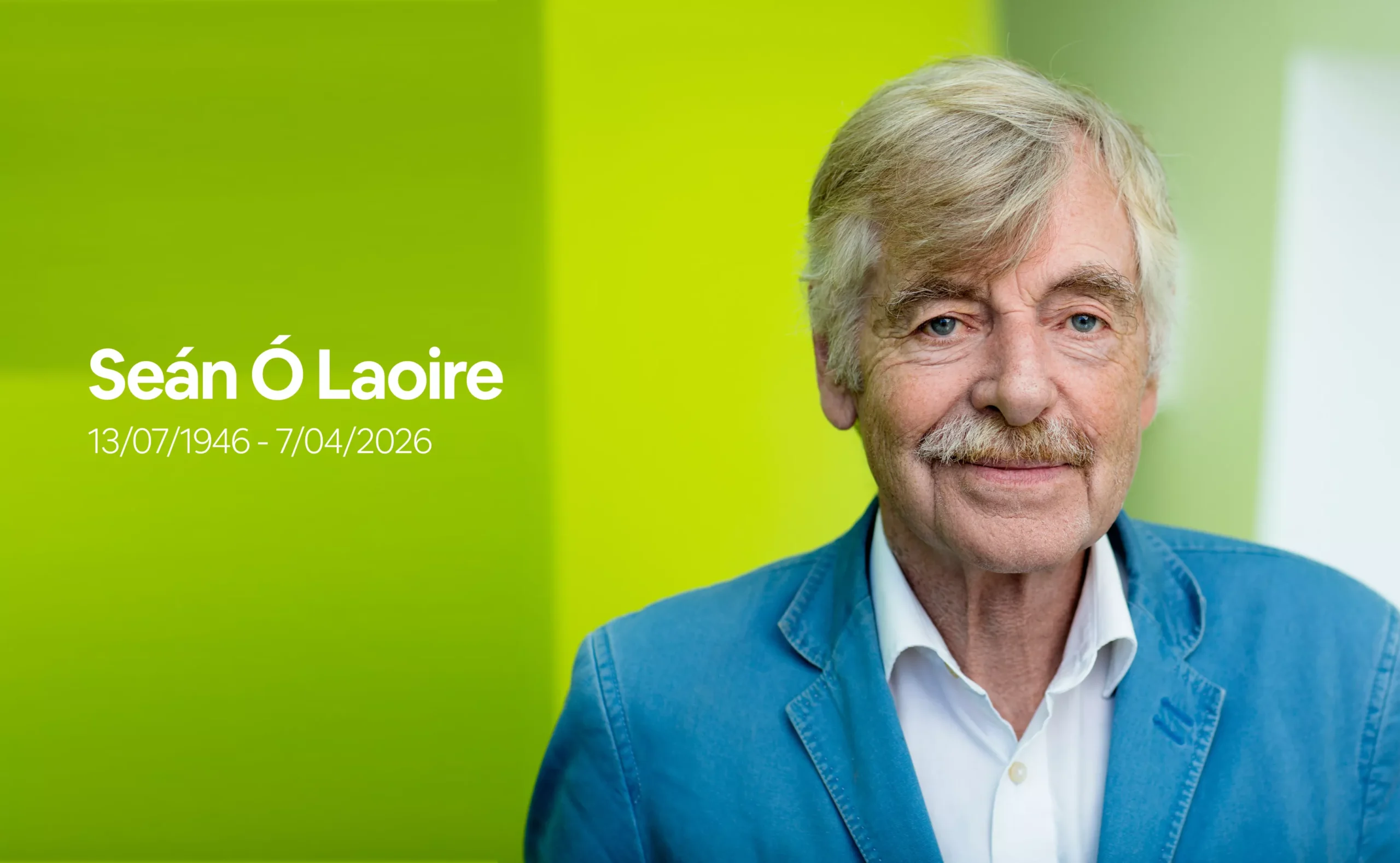
Seán O’Laoire.
13/07/1946 – 7/04/2026
It is with great sadness that we note the passing of our cherished colleague, friend, mentor and former Director Seán Ó Laoire.
Seán was one of Ireland’s most influential architects and urban designers of the late 20th and early 21st centuries, whose work connected practice with wider urban thinking and public discourse. Educated at University College Dublin and later at the University of California, Los Angeles, his early experience across Italy, Britain and the United States informed a humanist and outward-looking approach to architecture and urbanism. On returning to Ireland, he lectured at the Dublin Institute of Technology before co-founding Murray Ó Laoire Associates with his university friend and colleague Hugh Murray in Limerick in 1979. This collaboration evolved into a highly successful practice which, at its peak, employed 280 staff and expanded into offices in Dublin, Cork, Moscow, Aachen, Warsaw and even the Caribbean. Elected a Fellow of the Royal Institute of the Architects of Ireland in 1993, and later serving as its President in 2008-09, he was a leading voice in the profession. He advocated for architecture as a socially engaged and civic discipline, contributing meaningfully to urban life, cultural identity and a more sustainable society. As RIAI President, he secured the formal registration of ‘Architect’ as a protected professional title, following a long and sustained campaign.
Beyond practice, Seán contributed to public and cultural discourse on Dublin’s urban history and identity, engaging with the city not just as a designer but as an interpreter of place. His work and writing consistently emphasised the value of regeneration, continuity and the lived experience of the city. It was always closely connected to its history, cultural life, art and literature. He served on many Boards and was Chairman of NCAD, the National Sculpture Factory in Cork and contributed to many cultural institutions such as the Bell Table and Triskel Arts Centre in Limerick. Sean was also a founding member of the Academy of Urbanism.
In 1995, Seán received the RIAI Triennial Gold medal for architecture for Arthur’s Quay Park and Tourist Information Office in Limerick. His legacy included an impressive portfolio of architectural projects ranging from the Expo 2000 Irish Pavilion in Hannover, King John’s Castle Limerick, the Irish College Leuven, development of Carton House Demesne, and many award-winning projects such as The Diving Bell, the Cork School of Music, Belvedere College SJ, and The Green Building in Temple Bar and TCD Dartry Student Residences. Notwithstanding these achievements, Seán’s real passion was for urban design, particularly docklands and port regeneration. His work included the Masterplan for the Titanic Quarter Belfast, the masterplan frameworks for the original IFSC competition in 1985, the Bord Gáis Dockland Framework at Grand Canal Basin and later Dublin Dockland Master Plans in 1997 and 2008, Dublin Port Conservation Strategy and the Diving Bell. His contribution was central to the transformation of the Dublin Docklands, with a lasting influence on the city’s development. His current project in Dublin Port sought to construct a unique Aeolian Harp and tidal Sea Organ at the terminus of the Dublin Port Greenway.
Seán was also a generous mentor and an influential figure to many within the profession. Beyond his considerable professional achievements, he is remembered as a brilliant and perceptive architect and urban designer, whose warmth, humility and natural charisma left a lasting impression. He had a rare ease with people, a presence that could light up a room, and a kindness that touched the lives of all those he encountered.
His legacy lies not only in the buildings and urban spaces he shaped, and in his influence on generations of architects who followed, but also in the lasting impression he made on people, touching the lives of all who had the privilege to know him.
He will be greatly missed by all in MOLA Architecture.
Our thoughts are with Seán’s family at this difficult time.
Ar dheis Dé go raibh a anam